Tool 10 · Tap tempo · Free · No signup
Tap tempo.
Play the song, tap any key or the pad on every beat, and the BPM settles as you go. Half and double time underneath, and a click at the tapped tempo to check it by ear.
Average
--
first tap to last
Median
--
ignores a stray tap
Half time
--
if you tapped every beat of a slow song twice
Double time
--
if you tapped every other beat
Tap along for eight beats or more; the number settles as you go. Stop for two beats and the next tap starts a new count, or press Escape. Turn the click on to hear a metronome at the tapped tempo, in time with your last tap, and check it against the song.
On the beat
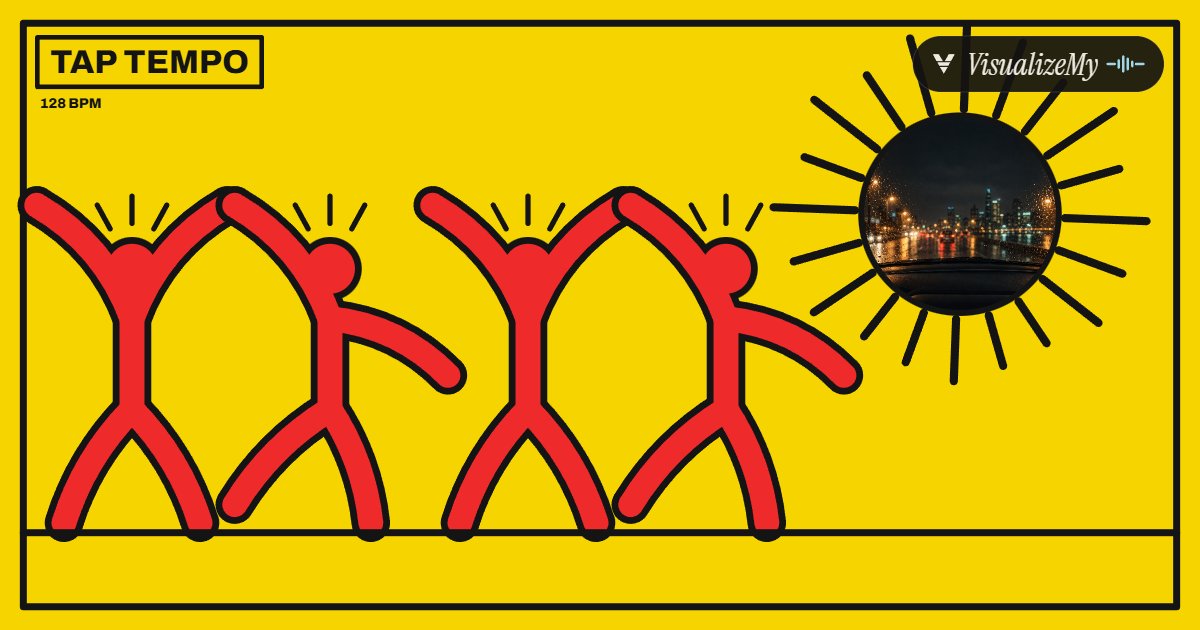
The frame above is the Haring style of our music visualizer: the figures change pose twice a beat and the whole row jumps on the kick. The visualizer finds the tempo of your file by itself; this page is for when you only have your ears.
How to find the BPM of a song by tapping
Software that detects tempo from a file is good and still gets fooled, most often into half or double time, and it needs the file. Tapping needs only that you can hear the song. Your taps are timed to the millisecond by the browser; the reading uses the median gap while you settle in and the full span once you are steady, which is how a drummer would count it with a stopwatch, only faster.
- Start the song and listen for the beat you would clap or nod to, usually the kick and the snare.
- Tap any key, or the pad on a phone, on every beat. Keep going for at least eight taps; sixteen is better.
- Read the BPM. When the average and the median agree and the line under the buttons says steady, you have it.
- If the number feels too slow or too fast for the genre, take the half time or double time reading.
- Turn the click on and play the song with it to confirm. Press Escape or Reset to start again.
Related
- BPM and key finderHave the file? Drop it and read the tempo and the key without tapping.
- MetronomeSet the tempo you found, any meter and accents, and practise to it or save a click track.
- Music visualizerNineteen styles that read the tempo of your file and move on the beat.
- Lyric video makerTime the words the same way: tap each line in as it is sung.
- Spotify Canvas makerA 3 to 8 second loop cut on the beat.
- All guidesHow-tos and comparisons from the people who build the tools.
Questions
How many taps does it take?+
Four taps give a rough number, eight give a usable one, sixteen or more get you within about one BPM. Each tap is off by a few hundredths of a second, even for a drummer; the error does not grow with more taps, it gets spread over a longer span, so the average gets finer the longer you keep going.
Average or median: which number do I use?+
The average is the gap from your first tap to your last divided by the number of beats, and after a steady run it is the more precise of the two. The median is the middle of all the gaps, so one late or doubled tap does not move it; it is the better number while you are still settling in, or if you know you fumbled a tap. When the two agree to within a beat, that is the tempo.
Why is my number half or double what the song is listed at?+
Because a beat can be felt at two speeds. A trap song listed at 140 feels like 70 if you tap the snare, drum and bass at 174 feels like 87, and a slow ballad at 70 turns into 140 if you tap every eighth note. Neither is wrong; the listed tempo is a convention of the genre. Half time and double time are shown under the reading so you can pick the one that matches.
Does it listen to the music?+
No. It only times your taps; there is no microphone and nothing is recorded or sent. That is also why it works for anything you can hear: a song on another device, a band in the room, a beat in your head.
Can I use it as a metronome?+
Yes. Tap the tempo in, turn the click on, and it plays a metronome at that tempo, starting in time with your last tap, with the first of every four beats higher. Play the song alongside and you will hear at once whether the number drifts ahead or behind.
Does it work on a phone?+
Yes, tap the big pad with a thumb. Taps register on touch, not on release, so the timing is the moment your finger lands. Bluetooth headphones delay the sound you hear by a fifth of a second or so, but the delay is the same on every beat, so the tempo you tap still comes out right.
What tempo are most songs?+
Roughly: ballads 60 to 80, hip-hop 85 to 100, pop 100 to 130, house 120 to 128, techno 125 to 140, drum and bass 170 to 175. Dubstep and trap are usually listed at 140 to 150 but felt at half that. A song outside its range is usually a half or double time reading, not an exception.