Images · Tool 90 · Images · Free · No upload
WebP to JPG.
Drop WebP images and get JPGs that open anywhere: set the quality and the background for transparent parts. Many at once, nothing uploaded, free.
01 WEBP images
Drop WEBP images anywhere here
As many as you like. They stay on this device.
02 JPG settings
JPG has no transparency: see-through parts get this colour. 92 is hard to tell from the original; 80 makes a noticeably smaller file.
03 Next
Made with this tool
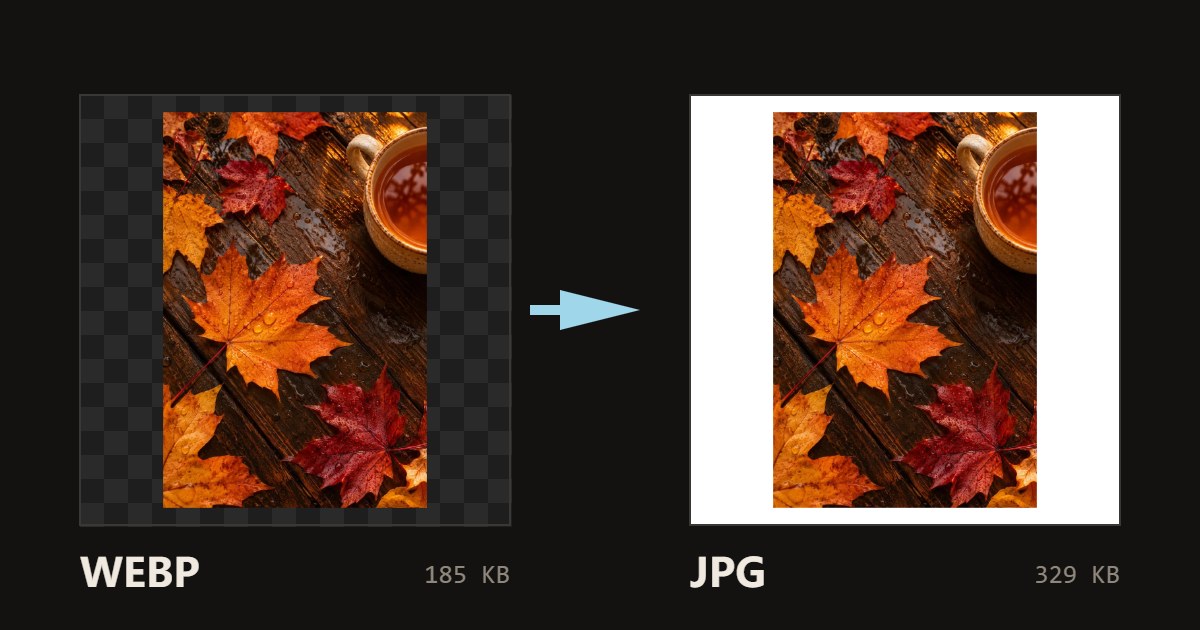
How to convert WEBP to JPG
Most images on the web are now WebP, and most of the world outside a browser still expects JPG: email attachments, print kiosks, older editors, government and school forms. Converting is the quickest fix.
JPG is lossy, so it trades a little detail for a much smaller file. At the default quality the difference from the WebP is very hard to see. Transparent areas, which JPG cannot hold, are filled with a colour you choose.
- Drop your WebP files on the page or press Choose images.
- Set the JPG quality, and the background colour if your images have transparent parts.
- Press Download next to a file, or Download all for a ZIP.
Related
Questions
Why convert WebP to JPG?+
Because JPG is the one image format every app, printer, phone and upload form accepts. Pictures saved from websites are often WebP, which older software and many forms still reject. JPG also keeps photos small, so it is the best choice when the picture is a photo and the size matters.
What quality should I choose?+
92 is the default and is hard to tell from the original. 80 to 85 cuts the file by roughly a third more with little visible change on photos; below 70, edges and skies start to show blocks. The size of each converted file is shown, so try a value and compare.
What happens to transparent parts?+
JPG cannot store transparency, so anything see-through is filled with the background colour you pick: white by default, black, or any colour. For a logo or sticker that must stay transparent, convert WebP to PNG instead.
Will the JPG be bigger than the WebP?+
Usually somewhat, because WebP compresses better than JPG at the same quality. At quality 80 to 85 a JPG is often close to the WebP size; at 92 it is typically larger. Both are far smaller than PNG for photos.
Are my images uploaded?+
No. The browser reads each picture and writes the new file on your device; nothing is sent to a server, which is also why it is fast and works on large batches. Close the tab and the files are gone from the page.
Can I convert many images at once?+
Yes. Drop or pick as many as you like; each is converted as it arrives and gets its own Download button, and Download all saves one ZIP. Very large photos, over about 16.7 megapixels, are scaled down to that size on iPhones because Safari will not draw anything bigger; the list says when that happened.
Is the photo data kept?+
The new file has no EXIF data: no camera model, date taken or GPS location. That is how browsers write images, and it is often what you want before posting a photo. The orientation is applied first, so a photo taken sideways on a phone comes out the right way up. If you need the metadata kept, use a desktop app such as Photoshop or GIMP.